

Skip directly to search Skip directly to A to Z list Skip directly to site content Skip directly to page options
CDC Home

Safe Healthcare

Hosted by CDC’s Division of Healthcare Quality Promotion

Share
Compartir

Risky pen pals

Categories: Injection Safety

Michael R. Cohen, RPh, MS, ScD, FASHP

Michael R. Cohen, RPh, MS, ScD, FASHP

Author – Michael R. Cohen, RPh, MS, ScD, FASHP
President, Institute for Safe Medication Practices

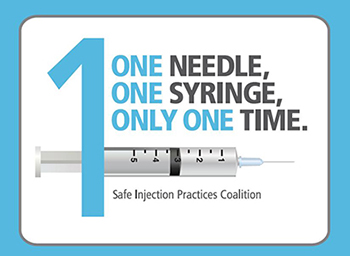
There’s an alarming and widespread misunderstanding about insulin pens by some healthcare workers who work in hospitals: that sterility can be maintained between patients simply by affixing a fresh needle on a previously used pen. Despite numerous warnings from the Food and Drug Administration (FDA), CDC, the Institute for Safe Medication Practices (ISMP), and insulin pen manufacturers themselves, evidence continues to mount that this dangerous practice is adversely affecting thousands of patients (Read recent clinical reminder).

Just this past month we received two new reports in which a nurse knowingly used the same insulin pen for more than one patient. As is typical in these scenarios, the nurses thought the practice was acceptable if they simply changed the needle between patients and kept the same insulin pen. In one of these cases it was later determined that the original patient had human immunodeficiency virus (HIV)! Follow-up tests were being conducted on the affected patient. The nurse involved in the event reported that sharing insulin pens was routine practice at another hospital where she had worked, as long as new needles were used. In the other report, two pens were used to administer insulin to three patients in an inpatient setting, even though each pen had a patient-specific label. One of the pens was borrowed from another patient while waiting for the pharmacy to dispense one for a new patient.

Parents Everywhere – Keep Medicines Up and Away

Categories: Medication Safety

Emily Skor, Vice President, Communications and Alliance Development, Consumer Healthcare Products Association

Emily Skor, Vice President, Communications and Alliance Development, Consumer Healthcare Products Association

Author - Emily Skor
Vice President, Communications and Alliance Development,
Consumer Healthcare Products Association

Nothing is more important for a parent than their children’s safety and well-being. As a mother of two young children, I know that we parents appreciate every reminder we can get as we juggle busy lives and balance many responsibilities. One reminder that rings true for me – keep medicines and vitamins up and away and out of sight of children, every time you use them.

Each year over 60,000 children under the age of five go to the emergency rooms because of unsupervised medicine ingestions. Parents can take action to protect their children from an accidental overdose of medicine by storing medicine safely, up and away and out of sight. This is the theme of an educational program launched recently by CDC and the Consumer Healthcare Products Association Educational Foundation as part of CDC’s PROTECT initiative, which works with leading safety experts to develop strategies for keeping our children safe.

Keeping Children Safe when Visitors Arrive – A message from family doctors

Categories: Medication Safety

Glen R. Stream, M.D., MBI, FAAFP

Glen R. Stream, M.D., MBI, FAAFP

Author – Glen R. Stream, M.D., MBI, FAAFP
President, American Academy of Family Physicians

With the holidays — and related family gatherings — quickly approaching, now is a perfect time to talk about keeping medications Up and Away and Out of Sight of children.

The CDC, with support from the American Academy of Family Physicians and other partner organizations, recently launched a program that aims to educate parents and other caregivers about the dangers of improperly storing medications in the home, protecting children from unintentional medication overdoses and what to do in the case of a medication-related emergency.

Many parents may not realize the dangers that medications and even vitamins may pose, but more than 60,000 young children in the U.S. end up in emergency rooms each year because they take these pills or liquids when an adult isn’t watching. Unfortunately, such incidents may occur during the holidays when grandparents and other relatives are in the home. 

Parents, please ask visitors to keep purses and bags that contain medication away from your children and out of sight. The same rule applies when your children are visiting a friend or relative’s home. That pill box Grandpa uses to organize his medications is probably not child-proof and should be kept up and away.

Three Words for Poison Prevention: Click, Up, and Away

Categories: Medication Safety

On Safety CPSC Stands For Safety

On Safety CPSC Stands For Safety

CLICK!
That’s the sound you often hear when you close the child-resistant cap on a medicine bottle.

Imagine this scenario: It’s the middle of the night and your sick child needs a dose of fever reducing medicine. You’re only half awake and caring for your child. You give your child the medicine and head back to bed.

CLICK. Did you hear it? Sometimes you won’t. But be sure the cap is closed tightly. Even in your most sleep-deprived hours, check the cap.

Hands closing a medicine bottle

Hands closing a medicine bottle

Most emergency room visits for medication overdoses involving 2-year-olds happen after children find and eat or drink medicines when adults aren’t looking, according to the Centers for Disease Control and Prevention. And each year, the nation’s poison control centers field nearly 600,000 calls for young kids and medicines.
This is why you need to put the bottles UP and AWAY.

Like many parents, you may think child-resistant caps fully prevent children from opening medications. Wrong. Child-resistant caps simply give you more time to prevent children from getting into medicines.

The regulation that covers child-resistant packaging works. Since the Poison Prevention Packaging Act was passed in 1970, there has been a 40% decline in aspirin poisonings alone with the use of child-resistant closures. That’s hundreds of children’s lives that have been saved.

Your vigilance can prevent the poisonings that continue to happen. Click, Up and Away.

Follow these steps to keep children safe around medicine:

Call Your Poison Center When the Unthinkable Happens

Categories: Medication Safety

Robert J. Geller, MD

Robert J. Geller, MD

Author: Robert J. Geller, M.D. Georgia Poison Center; American Association of Poison Control Centers

It’s a moment of sheer panic. You find your child chewing something and holding an open bottle of medicine. You don’t know how much, if any, medicine your child swallowed, or if it will make your child sick.

Unfortunately, as a pediatrician and poison center medical director, I’ve seen this happen all too often. In 2009, in fact, America’s 57 poison centers received more than 575,000 calls involving children younger than 6 and medicines – including prescription and over-the-counter drugs, herbal products, and vitamins.

When that moment of panic happens, it’s good to know that help is just a phone call away.

Older Posts Newer Posts

Pages in this Blog
 
USA.gov: The U.S. Government's Official Web PortalDepartment of Health and Human Services
Centers for Disease Control and Prevention   1600 Clifton Rd. Atlanta, GA 30333, USA
800-CDC-INFO (800-232-4636) TTY: (888) 232-6348 - Contact CDC–INFO
A-Z Index
  1. A
  2. B
  3. C
  4. D
  5. E
  6. F
  7. G
  8. H
  9. I
  10. J
  11. K
  12. L
  13. M
  14. N
  15. O
  16. P
  17. Q
  18. R
  19. S
  20. T
  21. U
  22. V
  23. W
  24. X
  25. Y
  26. Z
  27. #