Cops and Cars
Posted on by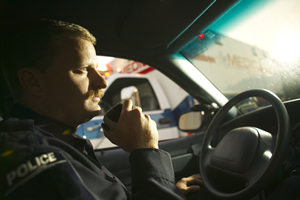 Law enforcement work remains a dangerous occupation. In 2009, the occupational injury fatality rate for police officers was 4 times higher than the U.S. average [BLS, 2009]. According to a new report by the National Law Enforcement Officers Memorial Fund, line-of-duty deaths have dramatically increased – 40% – from 2009 to 2010 (NLEOMF, 2010). Possible reasons for this significant increase include budget cuts, the expiration of semi-automatic weapon bans, and a diminishing respect for police officers; but these are, at best, speculations.
It is not surprising that officers face an increased risk for occupational motor-vehicle death. Officers spend a great deal of time performing vehicle patrols, can be involved in high-speed chases, are often on the roads in inclement weather, and have a variety of objects in their patrol cars that divert their attention from driving. Officers are also at risk while outside of their vehicles when performing work along busy highways and interstates. While seat belt use significantly reduces the chances of dying in a motor-vehicle crash, there is some evidence that officers do not wear seat belts (Cowan JA, et.al., 2006; Oron-Gilad T, et. al., 2005; Eun Young N. 2011). In 2005, researchers viewed a random sample of 250 driving scenes from the reality-based television series COPS and found that seatbelts were used in only 38% of the scenes (2006). The National Highway Traffic Administration (NHTSA) recently published a review of motor-vehicle fatalities among law enforcement officers and found that between 1980 and 2008, 42% of the officers killed had used a seatbelt (2011).
NIOSH is undertaking what we believe to be the first state-wide study of attitudes and beliefs of seatbelt usage among law enforcement officers. This study will survey a random sample of Iowa law enforcement officers through their agency leadership. The study will include officers in municipal departments, the state patrol, and sheriff’s offices. As we begin this research, we would like to use the NIOSH Science Blog to hear from police officers, police administration, law enforcement unions, training academies, and motor-vehicle researchers about their experiences with motor-vehicle crashes and the usage of seatbelts while in patrol cars. We appreciate your comments. They will be invaluable in informing this research and ultimately the evidence-based prevention programs that are generated.
Thank you for your assistance.
Dr. Tiesman is an injury epidemiologist in the NIOSH Division of Safety Research.
Dr. Heick is a faculty member in the Public Health program at Walden University.
43 comments on “Cops and Cars”
Comments listed below are posted by individuals not associated with CDC, unless otherwise stated. These comments do not represent the official views of CDC, and CDC does not guarantee that any information posted by individuals on this site is correct, and disclaims any liability for any loss or damage resulting from reliance on any such information. Read more about our comment policy ».
I have been a police officer in southwest ohio for 3 years now and do not wear my seatbelt on duty. I do not because I want easy access to my duty weapon if need be. Also, in case I need to exit my vehicle quickly for a foot pursuit.
To put my comments in context, I have been a law enforcement officer since 1984, and have been a full-time training administrator for the past decade. I’ll take exception to the concept of there being “good” reasons for officers to not wearing seatbelts – they tend to be rationalizations that echo the “good” reasons officers will give for not wearing soft body armor. The ergonomics and space constraints make a modern patrol car’s cockpit a difficult place to wear a duty belt, but adding in the additional girth and weight of the all-too-frequently borderline obese and out of condition officer only compounds the problem. And seatbelts aren’t “sexy.” If I proposed a two-hour in-service training block on buckling, unbuckling and getting out of a car in a hurry, I’d be laughed out of the business.
Many, if not all, car makers offer extenders for their seatbelts, typically as an accessory for the over-weight, but they can also be used for the extra length and flexibility needed to accommodate a duty belt and body armor.
You don’t hear fighter pilots complain about wearing five-point harnesses in ejection seats, and how uncomfortable parachute harness can be. While our occupation carries the risk of violent death, right now it appears that our biggest threat is ourselves and our driving habits. And bottom line, seatbelt use isthe law, and they save lives. I have personally known of several officers killed in crashes in which their driving and their failure to wear restraints likely contributed significantly to their deaths.
Thank you for the opportunity to voice my opinion.
19 years on, tons of traffic stops and some foot pursuits. I can’t imagine not wearing a belt. Its so automatic that I don’t even think about it. Never been a problem with quick exits or the rare occasions where I drew my weapon while in the seated position. The only change has been to stop using the extender as it fails to position the belt correctly.
Now, the holster against the seat belt stalk and the resulting misalignment of the spine…A whole diferent story!
I have 15 years in service, the last 5 at the state training academy instructing crash reconstruction. I agree with Bill Deweese. The reasons are only rationalizations. My home agency does include training for un/buckling in a hurry as part of the FTO program. The car doesn’t need to be at a dead stop to do either, just at a slow speed, so possible impact causes minor injury. With the current vehicle designs and after market contraptions we are now putting in our cars, the only way to be assured of “easy access to your duty weapon” is to get off your butt and climb out of your car when someone approaches. Are you practicing drawing and shooting from a seated position at the firing range? Attempting to do this in a panic sounds like a guaranteed round out through the windshield or into your leg.
18 years on the Kentucky State Police. You react like you train. I don’t put the car in gear without my seatbelt. No excuses. I, too, have unfortunately witnessed officers suffer injury and death for failing to abide by the simple task of applying their seatbelt.
I am not a police officer, nor do I pretend to even know what it’s like to need to exit the vehicle quickly, but for their own safety and security, especially when traveling at high speeds, to me it seems like common sense to ensure your own safety first and wear your safety belt.
I am not a police officer, but I work in occupational health and safety (OHS). For your information, a new car seat (the CS7/24) has been designed by the CROI company (http://www.croi.qc.ca/) for people wearing a duty belt. It has been presented in an OHS exposition in Montreal, one or two years ago. The seatbelt doesn’t interfere with the duty belt allowing a quick and easy exit from the pc.
I am an EVOC instructor for the LAPD. Prior to the, I was An accendent investigator for the department. Our policy requires seat belt use, but allows for the officer to remove the belt just prior to deployment or arrival(but not too early). We teach a sweep-away technique that works very well at crealy the duty gear. I have in fact timed about 40 officers in exiting a vehicle and simulating comig on target (both belted and un belted were given prepatory commands), the average difference was approximately .2 secs. The other point we teach to new and existing officers is, if you are not willing to exit the vehicle right now (based on speed), then you should be belted. It is one thing to be creeping around looking for suspects, but getting up to any speed unbelted is foolish. To not wear a seatbelt while on duty would be foolish and lazy, when policy (our department anyway) allows for early removal or tactical considerations (controled evironments-warrant services). Please feel free to contact me with any questions.
Officer Douglas Barnhart-LAPD-EVOC
In Oregon, Cell phone use is outlawed while driving, but police are exempted. Cell phone and computer use while driving is probably related to increased injuries while driving.
Distracted driving is dangerous, no matter who the driver is. The end doesn’t justify the means here.
That is just an excuse, how many times have you heard about an officer being injured because of limited access to his/her weapon vs how many times have you heard about an officer being injured as a result of a MVA.
Look at the numbers.
I have been a police officer for over 22 years. I have also been a crash reconstructionist for over 10 years. Folks who don’t wear the seatbelts are taking unnecessary chances. I have changed over to a high ride holster, and found that the seatbelt has NO effect with this. Having worked several fatal crashes and dealing with the issue of the driver/occupants not being restrained inside the vehicle, I cannot imagine why anyone would not WANT to wear it, regardless of the law stating that it is mandatory. The chances of survival are greatly increased when wearing a seatbelt. This is due to several reasons, not the least of which being that the seatbelt increases the amount of time in which the human body absorbs the change in velocity. The milliseconds do make a difference. The manufacturers have been attempting to make the vehicles safer, but there are limits to what they can do, take advantage of the safety measures that are available and survive to go home at the end of the shift.
Lt. D. C. Harris
I have been in Florida Law Enforcement for 20 years. The first 18 year I never used my seatbelt. I work within the city, my speeds are most of the time are below 40 mph. The last 2 years it has become policy to wear the seatbelt or get wrote up. I do not like the seatbelt on patrol because it is hard to get to my duty weapons (gun or taser) seatbelted in. Also, in the case I have to exit quickly to chase a suspect on foot it really gets in the way. I hope someday it does not cost me my life.
On the other hand, when I am on the highway to the county jail or other tasks. I don’t mind wearing the seatbelt. Here in Florida the law states everyone MUST wear their seatbelt while in the front seat of a motor vehicle. However a paper carrier don’t. Tell me that makes any sence.
I just recently retired from law enforcement here in North Carolina. I started in 1978 when seat belts were not used. I have been in at least five diffrent vehicle accidents in patrol vehicles, and the use of a seatbelt kept me from receiving serious injury. In one incident it allowed me to maintain control of my partrol vehicle and colliding with another vehicle. I have seen officers that were involved in accidents that had they not had a seatbelt on they would have received serious injury, or death.
I am a Forest Ranger with full police, game, fish & boat code authority and we are armed. I always wear the seat belt except on occasion when traveling less than 25 mph on state forest roads. Seat belt design is extremely poor while wearing a duty belt and even worse when you add a winter coat. There should be developed a buckle extension to ease the latching use by the officer. There are a “few” seat belt extensions and not one for every vehicle and every manufacturer. I drive a Chevorlet Tahoe or a Silverado pickup truck.
I have been in law Enforcement for 26 years I have been in involved in 2 head on collisions while responding to emergency’s- (all the drivers were at fault mostly due to inexperince( teenagers ) My first would have been my last as I had a seat belt on and still hit the steering wheel with such force it put an inprint of the steering wheel in the steel shock plate I had in my vest.This was prior to air bags and anti-lock brakes. I can only say that having a seat belt on is as essential as having bullets in your gun you never know when an accident is going to happen.Just as you never know when you will need your weapon..imagine in a shoot out situation you said as your final words “if only I had put the bullets in my gun” The same goes for seat belts it should be as automatic as putting your foot on the break pedal to place a vehicle in drive you do it without thinking.
So, let me get this right…I could get pulled over and ticketed by a police officer who might not use a seat-belt. No wonder the respect for police officers continues to slip into the gutter.
I’ve been in service in PA for 5 years now and as the punishment for DUI in PA was toughened so did the death rates among police officers. Is there any logical connection?
My significant other was in the Marines for 5 years ans is now looking to be a Police officer and despite the respect that I have for Law Enforcement I am totally against it because I these statistics and the dangers that officers face everyday. Of course I move towards everyone wearing seat belts but I sometimes cant pull my seat belt off right away.
I see how for police officers, that can be a hindrance in a critical situation where every second counts. It is a double edge sword. If officers were forced to wear seat belts, you would see a decrease in the number of deaths from traffic accidents but then would you see an increase in line of duty deaths?
There really should be no exceptions to police wearing seatbelts. Your data shows the risk of danger is far higher by not wearing one vs the risk from not exiting the car 2 seconds faster.
Also, let’s look at electronic distractions that police must contend with. Does the increase in MVAs correlate with the increase in technology? Police now have onboard computers in addition to cell phones.
People are quick to laugh at safety issues, but I’m not. As a kid, I used to not be the biggest fan of police, but we need them. And we need them to be safe too. I’ve worked in window tinting for 12 years and we’d have people complain about the laws restricting it. But the more I learned, there’s laws for that because if an officer is on a traffic stop, he needs to be able to ensure he’s dealing with safe citizens. My cousin-in-law is a police officer, and you wouldn’t want to hear half of the stories he tells me. They’re downright scary.
Seatbelts too. That’s another thing that contributes to safety (I think we’re all well aware). But seriously. Why would someone not wear it when it takes a split second? People should be stopped for not wearing seatbelts. My cousin in law has worked accidents where lives could have been saved.
But that aside, being in law enforcement…these guys put their butts out there for us every day. Are there some misguided ones? Yes. But that’s true in any profession. Law enforcement safety HAS to be a leading issue (but sadly most people fail to pay attention).
I respect the heck out out of what these guys do. Sadly, they don’t get the public respect they truly deserve.
“The National Highway Traffic Administration (NHTSA) recently published a review of motor-vehicle fatalities among law enforcement officers and found that between 1980 and 2008, 42% of the officers killed had used a seatbelt (2011)” – That’s really strange. But wearing seat-belts is very important. Exceptions are there, but that does not mean that after knowing the accidental cases people will stop using seat-belts. Officers should always use seat-belts to make examples. Seeing the officers wearing seat-belts, at least some percentage of the common people will also start wearing it.
The one area where police officers are faced with accidental deaths similar to these other fields is traffic accidents, which annually claim the lives of more officers than do intentional or felonious actions by others.
Thanks for this information, its really help for other.
The one area where police officers are faced with accidental deaths similar to these other fields is traffic accidents, which annually claim the lives of more officers than do intentional or felonious actions by others.
I definitely agree with this statement.
Hats off to all of our law enforcement officers. They risk their lives every day to protect and serve. My daughter has a friend who’s father was killed in the line of duty. His hometown erected a stature of himself and his two children. They were very young when he was killed but still remember him. Very sad. Let’s hope that budget cuts in cities across the U.S. don’t affect the future safety of our officers.
Interesting article, it would be nice if the posted an update on their findings. I’ve tried searching google, but haven’t found anything… If anyone knows please post!
Jason B
Vehicle Safety & Quality Assurance
Would it be possible to do an article on Dubai Police Cars? They have patrol cars such as Ferrari! It’s just an interesting contrast when you compare the USA and Dubai.
I think that the cops doing a lot of works, thanks for them!
And thanks for this article, I loved it!
This is an interesting article about Cops information. Cops are doing a lot of work for keeping patience in society. And this article describe everything about that. So thank you for your post.
20 years on the Kentucky State Police. You react like you train. I don’t put the car in gear without my seatbelt. No excuses. I, too, have unfortunately witnessed officers suffer injury and death for failing to abide by the simple task of applying their seatbelt.
Thanks for this information, its really help for other.
Interesting article, I think that the cops are doing a lot of work, thanks to them! Thanks for this information, it will really help others.
No excuses, All people should drive your car with put seat belt.
Thanks for your nice post . I hope I will see this type of post again
thanks & regards
Thanks for this information.
Nice sharing…
Thanks for this information, its really help for other.
I have 15 years in service, the last 5 at the state training academy instructing crash reconstruction. I agree with Bill Deweese. The reasons are only rationalizations. My home agency does include training for un/buckling in a hurry as part of the FTO program. The car doesn’t need to be at a dead stop to do either, just at a slow speed, so possible impact causes minor injury. With the current vehicle designs and after market contraptions we are now putting in our cars, the only way to be assured of “easy access to your duty weapon” is to get off your butt and climb out of your car when someone approaches. Are you practicing drawing and shooting from a seated position at the firing range? Attempting to do this in a panic sounds like a guaranteed round out through the windshield or into your leg.
laws and cops should go side by side
You don’t hear fighter pilots complain about wearing five-point harnesses in ejection seats, and how uncomfortable parachute harness can be. While our occupation carries the risk of violent death, right now it appears that our biggest threat is ourselves and our driving habits. And bottom line, seatbelt use isthe law.
I have 12 years in Turkey Police Service,there is really good service and i love there.
Thanks for the information its so helpful for us.
I have been researching case studies from crashes that range from laws regarding the fight of DUI offense prevention, to traffic and seatbelt violations. I am curious to see how previous case studies compare with seatbelt usage among law enforcement officers who are involved in accidents.
Much like how officers risk their safety with drivers who fight dui charges from operating a car while drunk or high, officers put themselves at risk not wearing seatbelts as well. Police put their lives on the line more than many people realize to keep us all safe.